15 juillet 2026 · 10 blog.minRead · sports-knowledge
The Substitution Board — How Football’s Simplest Piece of Technology Changed the Game Forever
July 15, 2026 · 9 min read
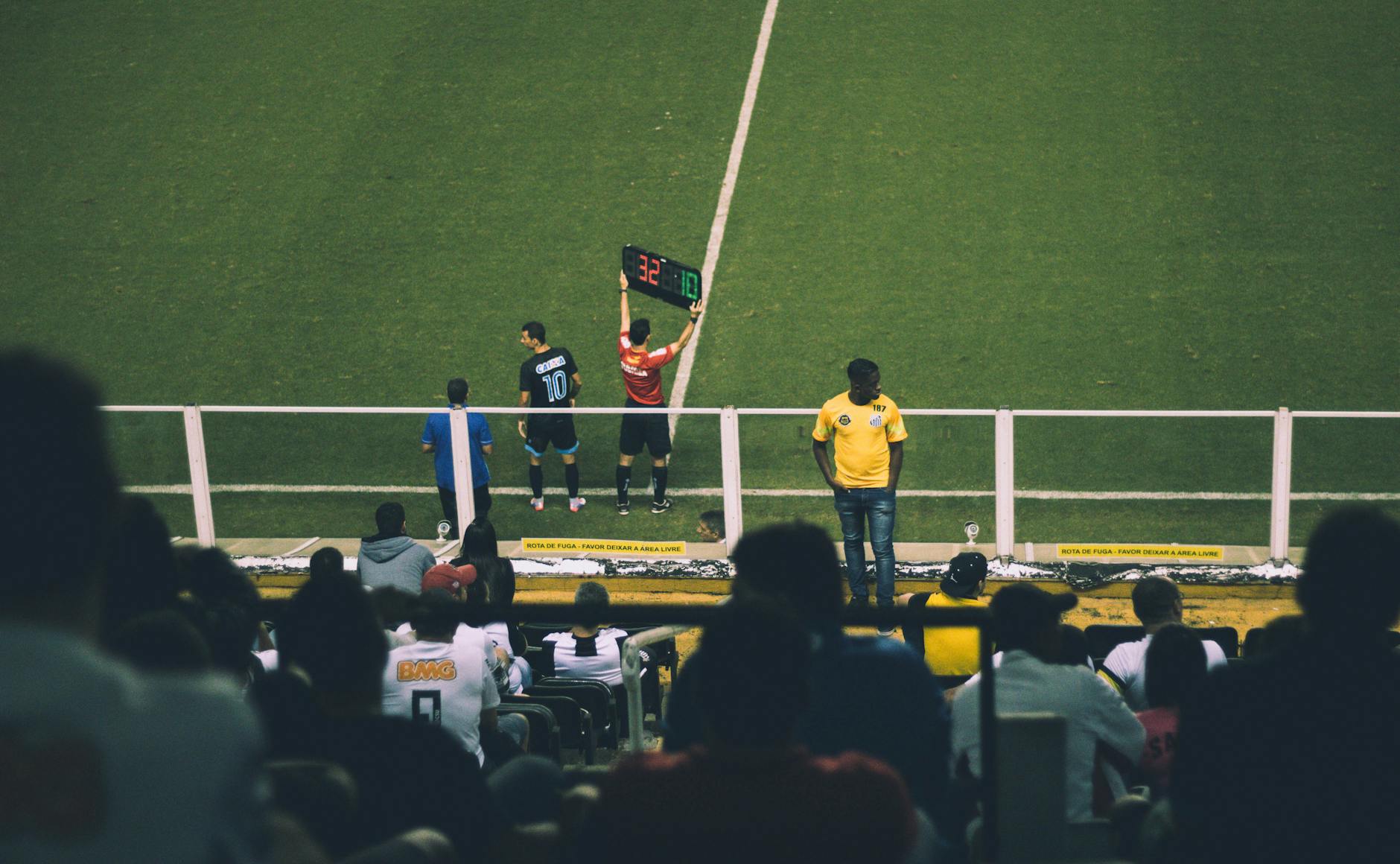
Every football fan has seen it — the glowing rectangular board that appears at the halfway line, displaying two numbers in contrasting colors. But the substitution board is far more than a signaling device. It’s the nerve center of one of the game’s most tactical moments, and its evolution mirrors the broader transformation of football from a simple sport into a multi-billion-dollar spectacle.
What Exactly Is the Substitution Board?
The substitution board — officially recognized in IFAB Law 3 as the mechanism for signaling player changes — is a handheld electronic display operated by the fourth official. When a team requests a substitution, the fourth official raises the board at the halfway line, displaying two numbers: the shirt number of the player leaving the pitch (typically in red) and the shirt number of the incoming substitute (typically in green or yellow).
The board serves a dual purpose at the elite level. In addition to substitution numbers, it also displays the minimum amount of additional time the referee intends to play at the end of each half. This dual function has made it one of the most recognizable pieces of equipment in world football — a device that every fan understands but few have thought deeply about.
According to IFAB Law 3.3, the substitution procedure is clear: the player being substituted “must be off the field of play within ten seconds of the substitution board being shown or, where there is no board, of the referee’s signal for the substitution to take place.” That ten-second window — enforced by the board’s appearance — has become one of football’s most important time constraints.
Before the Board: A World of Hand Signals and Confusion
Substitutions were not always part of football. They were officially added to the Laws of the Game in 1958, and even then, only for injured players. The first substitute in a senior international match was used in 1965, and it wasn’t until 1970 that substitutions were permitted at the World Cup.
In those early decades, signaling a substitution was a chaotic affair. The referee would simply wave the incoming player onto the pitch, often while the outgoing player was still jogging off. There was no formal visual signal for the crowd, no numbered display, and no standardized procedure. Fans in the stands frequently had no idea which player was being replaced until the new number appeared on the team sheet — if they were lucky enough to have one.
The introduction of the fourth official role — which became standard in top-flight football during the 1990s — changed everything. With a dedicated official positioned between the two technical areas, there was now someone whose primary job was to manage the administrative side of the match, including substitutions. The substitution board became that official’s most visible tool.
From Paddles to Pixels: The Evolution of the Board
The earliest substitution boards were simple mechanical devices — essentially numbered paddles or flip boards that the fourth official would hold up manually. These required the official to physically swap numbered plates, a process that was slow, error-prone, and nearly impossible to read from the far side of a large stadium.
The transition to electronic LED boards in the late 1990s and early 2000s was a quantum leap. Modern substitution boards use bright LED or LCD displays that are visible even in direct sunlight or heavy rain. The numbers are typically 20-30 centimeters tall, readable from 100+ meters away, and powered by rechargeable batteries that last an entire match day.
Today’s boards at the World Cup and other elite tournaments are manufactured by companies like Swiss Timing (part of the Swatch Group) and feature:
- Dual-color displays: Red for the outgoing player, green or yellow for the incoming substitute — a visual language that fans worldwide instantly understand.
- Integrated time display: The same board shows added time at the end of each half, eliminating the need for a separate signal.
- Lightweight construction: Modern boards weigh under 2 kilograms, compared to 5+ kilograms for early electronic models.
- Weather resistance: IP65-rated enclosures protect against rain, dust, and the occasional celebratory splash from a water bottle.
The Fourth Official’s Ballet
Operating the substitution board is far more complex than it appears. IFAB Law 6.2 specifies that the fourth official’s duties include “supervising the substitution procedure” and “indicating the minimum amount of additional time the referee intends to play.” But the reality of managing a substitution involves a precise choreography:
- The team manager or coach informs the fourth official of the intended substitution, often via a written slip or verbal communication through the technical area.
- The fourth official verifies the substitution is legal (the team has substitutions remaining, the incoming player is eligible, and there are no disciplinary issues).
- The fourth official waits for a stoppage in play — the substitution can only be made during a break in the game.
- The board is prepared with the correct numbers and shown at the halfway line, clearly visible to the referee, both teams, and the crowd.
- The ten-second countdown begins. The outgoing player must leave the field within this window, or the referee can take action.
- The incoming player enters at the halfway line, after the outgoing player has left, and only after receiving the referee’s signal.
This sequence must be executed flawlessly, often multiple times per match, sometimes with three substitutions happening simultaneously in a triple change. The fourth official’s ability to manage this process under pressure — with millions watching and a manager screaming instructions — is one of football’s underappreciated skills.
When the Board Goes Wrong
Despite its simplicity, the substitution board has been the source of some memorable controversies and incidents:
Wrong number displayed: There have been instances where the fourth official raised the board with the wrong shirt number, leading to confusion about which player was actually being substituted. In one famous incident, a player who was not being substituted began walking off the pitch because he saw his number on the board — only to be told by his manager to stay on.
Players refusing to leave: IFAB Law 3.3 addresses this directly: “if a player who is to be substituted refuses to leave, play continues.” This has happened several times in high-profile matches, most notably when a player disagrees with the manager’s decision or wants to stay on during a critical moment. The board goes up, the player ignores it, and the game continues — creating an awkward standoff between player, manager, and officials.
Electronic malfunctions: In the early days of LED boards, battery failures and display glitches were not uncommon. A fourth official holding up a blank or flickering board while the referee waits is a uniquely modern football problem. Modern boards have largely eliminated these issues with redundant power systems and robust construction.
The ten-second rule enforcement: Since the introduction of the ten-second rule, referees have had to decide how strictly to enforce it. A player who takes 12 seconds to leave is unlikely to be punished, but a player who deliberately stalls for 30 seconds while his team defends a lead creates a genuine enforcement dilemma.
The Board at the World Cup 2026
At the 2026 World Cup in the United States, Canada, and Mexico, the substitution board has taken on additional significance. The tournament’s five-substitution rule — permanently adopted by IFAB in 2022 — means more substitutions per match than ever before. Teams now have five changes across three substitution opportunities in normal time, plus an additional opportunity in extra time.
This has transformed the substitution board from an occasional sight into a constant presence. In the knockout stages, where managers are making tactical adjustments every 15-20 minutes, the board has appeared more frequently than in any previous World Cup. The 2026 tournament has also introduced concussion substitutions as a permanent provision, adding another category of player change that the fourth official must manage.
The expanded 48-team format means more matches, more substitutions, and more pressure on the officials who operate the board. With three host nations and venues spread across a continent, the consistency of the substitution board protocol has become a key part of FIFA’s officiating standardization efforts.
More Than a Board: The Psychology of the Signal
The substitution board is not just a practical tool — it’s a psychological trigger. When the numbers go up, the entire stadium reacts:
- The substituted player: Reactions range from philosophical acceptance to visible frustration. Some players applaud the crowd as they walk off; others kick the advertising boards or argue with the manager. The board’s appearance forces an immediate emotional response.
- The incoming substitute: The board is the green light — the moment a warm-up becomes a match. Heart rates spike, adrenaline surges, and the substitute has seconds to switch from training mode to competitive mode.
- The opposition: Seeing a star player’s number on the board can be either a relief (the threat is removed) or a warning (whoever is coming on might be even more dangerous). Managers on the opposing bench immediately begin recalibrating their tactical approach.
- The crowd: The board is a shared experience. 80,000 fans in a stadium — and billions watching at home — all see the same numbers at the same moment. It’s one of the few moments in football where the entire audience’s attention is focused on a single object.
The Future of the Substitution Board
As football embraces more technology, the substitution board is likely to evolve further. Some proposals that have been discussed at IFAB level include:
- Integration with VAR: Future boards could display confirmation that a substitution has been reviewed and approved by the video assistant referee, particularly for concussion substitutions.
- Player tracking integration: Boards could work alongside GPS tracking systems to ensure substituted players leave the field within the designated time window, with automated alerts if the ten-second rule is violated.
- Fan-facing displays: Stadium screens could mirror the board’s information with additional context — the substituted player’s match statistics, the incoming player’s recent form, and tactical analysis of the change.
But the fundamental design — two numbers, two colors, one official — is unlikely to change. The substitution board’s genius lies in its simplicity. In a sport increasingly dominated by complex technology, the board remains a beautifully straightforward solution to a simple problem: telling everyone on the pitch and in the stands who is coming off and who is going on.
Key Takeaways
- The substitution board is officially recognized in IFAB Law 3.3, which gives players ten seconds to leave the pitch after it is displayed.
- The board serves a dual function: signaling substitutions and indicating minimum added time at the end of each half.
- The transition from mechanical paddles to electronic LED displays in the late 1990s transformed the board into one of football’s most visible pieces of technology.
- The five-substitution rule at the 2026 World Cup has made the board a more frequent presence than in any previous tournament.
- The board is more than a signaling device — it’s a psychological trigger that affects players, managers, and fans simultaneously.